Tuesday, 5 March 2013

Sins of a Stitcher!


 I only went for the Talks- Honest!


These were cut 1/2 metre lengths from
The Dyeworks
based in Gloucestershire
www.dyeworks.co.uk/contact.html


Polly Lyster trawls France and Turkey for linen fragments to dye


She makes recipes based on natural indigo
and then dip-dyes
up to ten times
to make these beautiful tints


Also found a clutch of linen spools!


My excuse was that I needed something for the journey home


Ohhh! and Meg Andrews had a fascinating darning sampler
from North Holland, stitched by Geertuid A. Kruyt.
The stitch patterns were very similar to twill weaving patterns
and looked like fantastic reference for field patterns!

Sunday, 3 March 2013

Manchester Antique Textile Fair

Just come back from a GORGEOUS day 
at the Textile Society's 'Antique Textile Fair' at 
the Armitage Centre in Fallowfied, Manchester!

This is an annual event, which celebrated its 21st birthday this year.
GEORGINA von ETZDORF ( of beautiful print fame)
was 'in conversation' with MARY SCHOESER
she had brought LOADS of scarves, ties, dressing-gowns etc with her
so THAT was a real treat!

In the afternoon there was a talk by JAQUELINE HYMAN
who is a textile conservator and worth listening to any time.
She was talking about the work she has done with Bolton Museum
on their Coptic and Ancient Egyptian textiles- she has such enthusiasm
and loves her work.
(I did a mini-course with her a number of years ago)

In between times I spent a small fortune on 'stuff''!
Mostly at 'DYEWORKS'
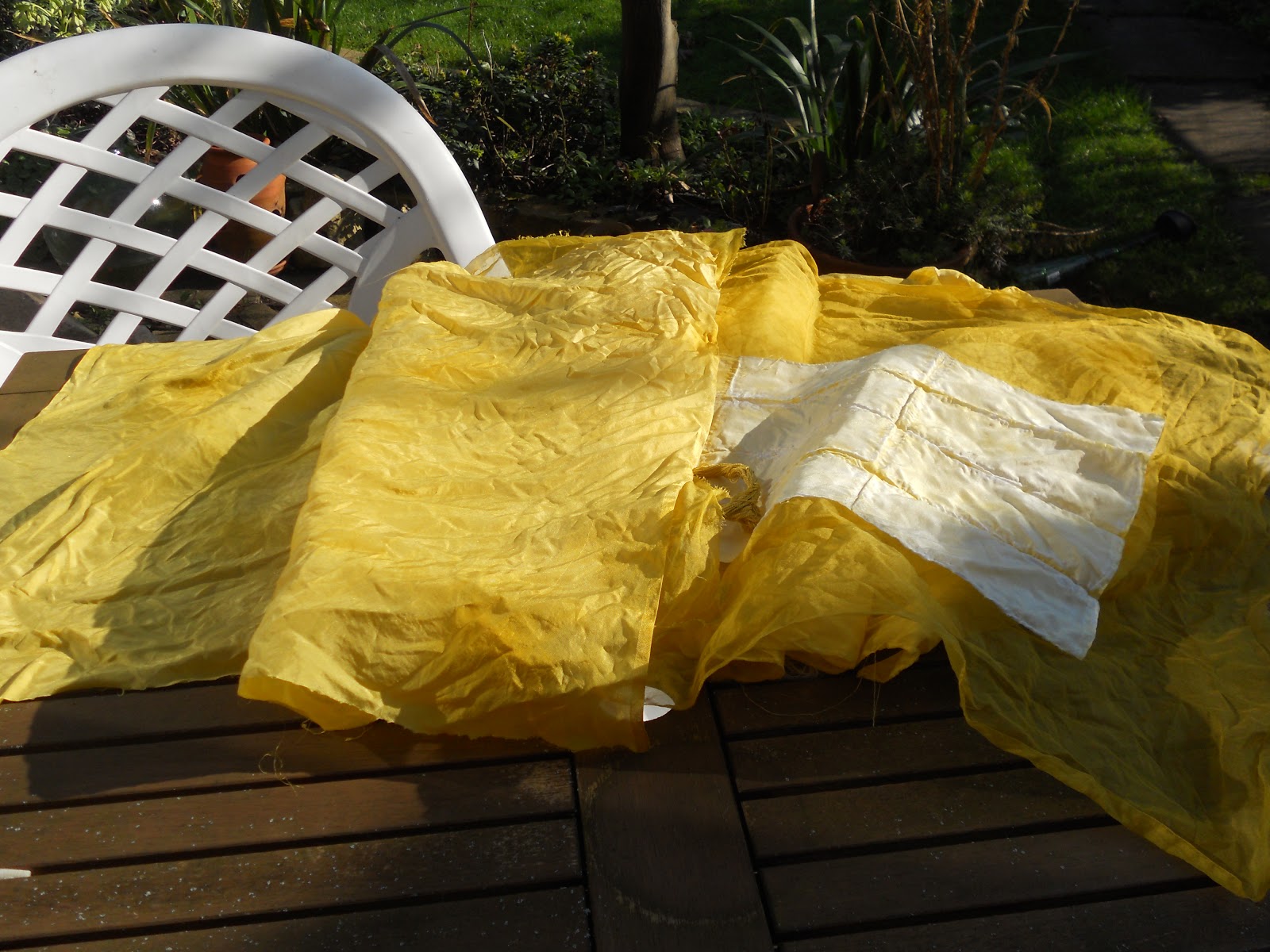
beautiful dyed linens
(you can see where this is going...)
beautiful LAND shades

then some linen threads (from a house clearance apparently)
a mini vacuum-cleaner from Jacqueline's 'RESTORE' stand-
(this is to give a commission of mine in the Quaker Meeting House in Chester
a Spring Clean)

then, cos I reckoned I could stitch some of this beautiful Linen
on the way home on the train
I went in search of some needles
(amazing hard to find surprisingly)

Will post photos tomo!

Tuesday, 19 February 2013

Here comes the Sun!! :D


Bin dying threads and fibres
to use with the
stitched and knitted
'Land Impression' blocks!


Bin preparing linen for smocking!

This beautiful cloth is kindly donated by a dear sister.
She gave me a pile of linen shirts!


I love working with linen as it seems to melt in your hands as you work with it.

Touch is such an important part of stitch and our relationship with cloth

(I've run out of pleated fabric that I've had stashed 
from a time when I borrowed a friend's pleating machine -
that was years ago)


Now it back to the 'iron' and 'gather' method

it takes time but it 'purrfect' for an evening with the cat
and 'Lewis'


Therese de Dillmont described 'smocking'
in her Encyclopedia of Needlework:

Decoration of the gathers, known as 'smocking'
This kind of work occurs in the national costumes of the Hungarians, 
as well as in England where it is still in vogue.
"Smock" is an old English word for shift or chemise, hence the term "smocking" came to be applied to the ornamental gathering of the necks of these garments
and also of the elabourate, beautifully embroidered "smock-frock" of the labourers...

( from page 13, under the chapter heading "Plain Sewing")

Thursday, 14 February 2013

Stitched and Knitted smocks for Collector's dolls 2003-5

 I first became interested in knitted and stitched smocks some years ago
as they seemed to represent the nearest the English had to a national costume


I spent happy hours researching children's clothing
visiting the costume collection at Platt Hall in Manchester


and studying French layette and children's underwear.

Why French?
Because the stitches were so small and the seams so tiny!


Then I cut scaled patterns for Collector's dolls
This doll above is 25" high, but most were 14 - 20".


The cardigan was knitted from Appleton's crewel wool
with size 20 needles (about the thickness of a paperclip)


Most of the dresses were made from Liberty's Tana Lawn

This how I remember being dressed when I was little-
in hand-me-down smocked dresses

Wednesday, 13 February 2013

Smocking and Authenticity


Last week I was using a linen yarn to knit CABLES
 from Cornish Knitted Smock patterns

I've also been stitching on linen 
using smocking patterns
and the flat embroidery found on the 'boxes', shoulders, collar and cuffs
of stitched agricultural smocks
to create TEXTURED SURFACES
that seem to me to echo marks in the landscape


       these patterns seem to me
 to echo the marks left by ploughing and harvesting


      by altering the stitching,
  marks can suggest marks from long ago
   or that are faded by weathering


 The tubes of the gathered smocking also reference the fieldscape


   The knitted cables have now been stretched   
 and made into blocks that can be used for 'Rubbings'.


 So over the next couple (of doubtless more-snowy) days
      I'll make the stitched smocking into blocks
 And then the FUN can begin!


     I use the traditional stitched and knitted 'folk art'
     as an 'authentic' reference to the rural history of our culture.

Friday, 8 February 2013

Work on the Wall- (part 2)


Well back to Work on the Wall-
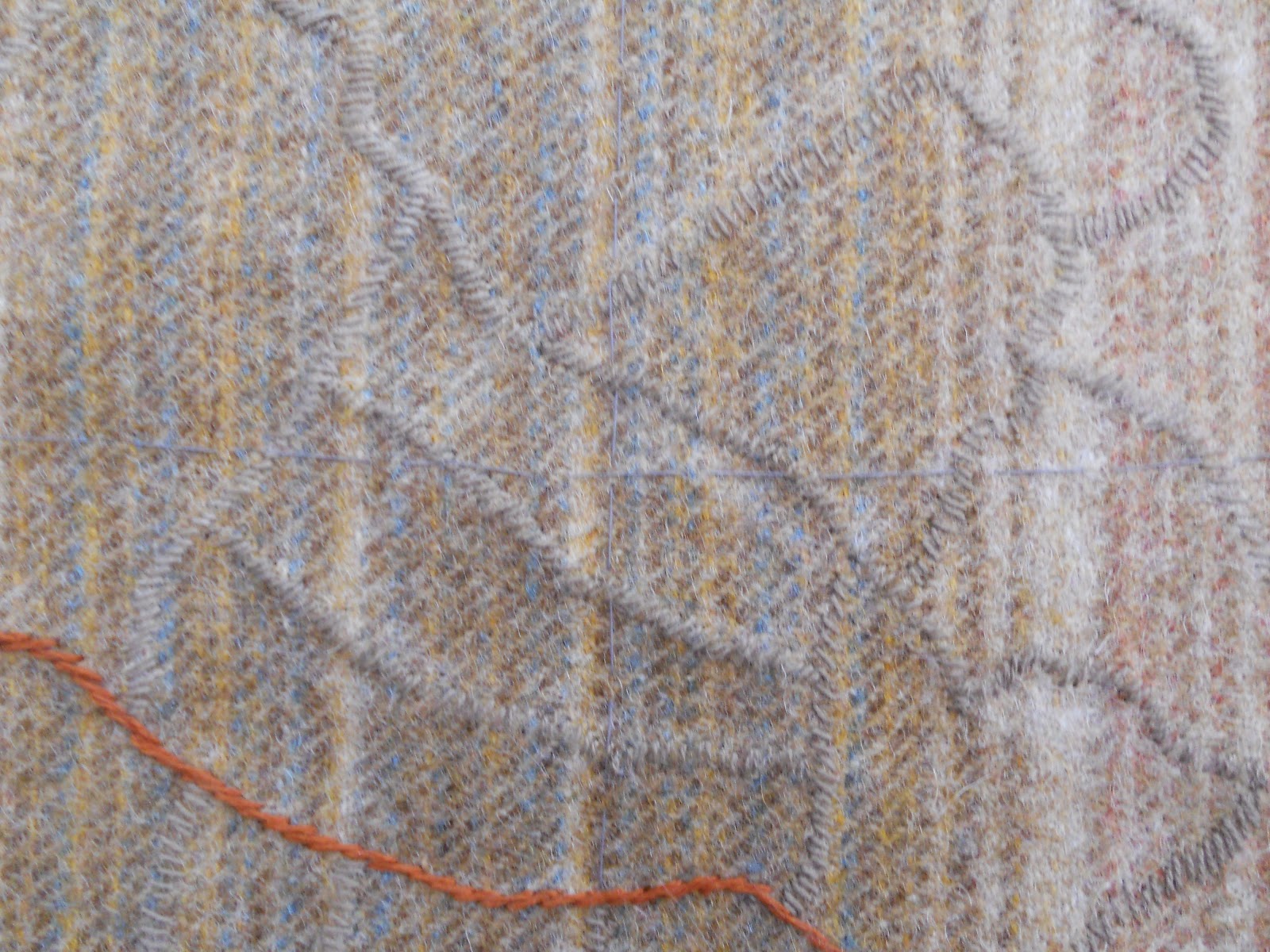
After working 'Raginnis Farm' on the twill tweed
I wondered how a striped tweed would look.


      'Raginnis Farm Field Boundarys'


   'RFFB'  (detail)

The weave and colouring of the fabric has assumed a greater significance.
To embroider a 'filling' on the field would (as my Grandmother would say)
"be too much of a muchness"


      'RFFB'  (detail 2)

                  To contrast with the linear striped weave I exaggerated the curves of the field markings.


'Above Trevalgan Hill'

Using the sketches I made on the workshop with Andrew Hardwicke
I made field images using a totally different trajectory from the aerial map.


'ATH'  (detail)

The elongated field pattern needed a different approach to the stitching
I used a 'kantha', stem stitch type marking
building colour and texture


    'ATH'  (detail 2)
                         
 Sometimes the stitch is spare, sometimes diagonal
     and sometimes overlaid.


 'ATH'  (detail 3)

  French knots make up the foreground heather


  See what I mean!


St Ives School of Painting workshop with painter Andrew Hardwick
I used alot of different textures on the ground, including original soil and plant material.


  Building up layers of colour
     The 'white' is actually PVA, which of course dries clear, 
      but then makes a very interesting resist
        when rubbing or glazing over the top.


And sometimes I paint!